Towing Guides
Before You Buy
- 2,000-lb maximum weight (trailer and cargo combined
- Small folding camping trailers and trailer for small bots, motorcycles, and snowmobiles
- Many Ford vehicles can handle easily
- Conventional weight-carrying hitch
- 2,001-3,500-lb gross trailer weight
- Large folding camping trailers, single-axle, small to medium length (up to 18ft) trailers
- Ford trucks and compact SUVs can be equipped to tow these trailers
- Conventional weight-distributing hitch not required unless specified for a particular vehicle
- 3,501-5,000-lb gross trailer weight
- Dual-axle or large single axle- travel trailers
- Most properly equipped Ford trucks and SUVs can tow them
- Conventional weight-distributing hitch not required unless specified for a particular vehicle
- Over 5,000lb gross trailer weight
- Largest travel and 5th-wheel trailers made for recreation
- Most Ford trucks and some SUVs can be equipped to handle trailer weights in this class
- Most applications require a conventional weight-distributing or 5th wheel hitch
- Base Curb Weight is the weight of the vehicle including a full tank of fuel and all standard equipment. It does not include passengers, cargo, or any optional equipment. A sales specialist can get you this number for the vehicle you are considering.
- Cargo Weight includes all weight added to the Base Curb Weight, including cargo and optional equipment (check with your sales consultant). When towing, trailer tongue load or king pin weight is also part of the Cargo Weight.
- Payload is the combined maximum allowable weight of cargo and passengers that the vehicle is designed to carry. It is the Gross Vehicle Weight Rating minus the Base Curb Weight.
- Gross Vehicle Weight Rating (GVWR) is the maximum allowable weight of the fully-loaded vehicle (including passengers and cargo). This number- along with other weight limits, as well as tire, rim size, and inflation pressure data - is shown on the vehicles Safety Compliance Certification Label, located on the front door lock facing the door latch post pillar. The GVW must never exceed the GVWR.
- Gross Axle Weight (GAW) is the total weight placed on each axle (front and rear). To determine the Gross Axle Weights for your vehicle and trailer combination, take your loaded vehicle and trailer to a scale. With the trailer attached, place the front wheels of the vehicle on the scale to get the front GAW. For rear GAW, weigh the towing vehicle with the trailer attached, but with just the four wheels of the vehicle on the scale. Subtracting front GAW from that amount gives you the rear GAW.
- Gross Axle Weight Rating (GAWR) is the maximum weight to be carried by a single axle (front or rear). These numbers are also shown on the Safety Compliance Certification Label. The total load on each axle must never exceed its GAWR.
- Gross Combination Weight Rating (GCWR) is the maximum allowable weight of the towing vehicle and the loaded trailer - including all cargo and passengers - that the vehicle can handle without risking damage. (Important: The towing vehicle's brake system is rated for operation at the GVWR - NOT GCWR. Separate functional brake systems should be used for safe control of towed vehicles and for trailers weighing more than 1,500lbs when loaded.) The measured GCW must never exceed the GCWR.
- Maximum Loaded Trailer Weight (as shown in the Trailer Towing Selector charts for each vehicle) is the highest possible weight of a fully loaded trailer the vehicle can tow, based on a minimum towing vehilce GVW. It assumes a towing vehicle with any mandatory options, no cargo, tongue load of 10% (conventional trailer) or king pin weight of 15% (5th wheel trailer), and driver and passenger. F-Series Super Duty Chassis Cab models also assume a second-unit body weight based on 80 lbs per foot cab-to-axel(CA).
- Tongue Load or 5th-wheel King Pin Weight is another critical measurement that must be made before towing. It refers to the amount of the trailer's weight that presses down on the trailer hitch. Too much tongue load or king pin weight can cause suspension/drivetrain damage and can press the vehicle down in back causing the front wheels to lift to the point where traction, steering response and braking can be severely decreased. Too little tongue load or king pin weight can reduce rear-wheel traction and cause instability, which may result in tail wagging or jackknifing.
F-150 Towing

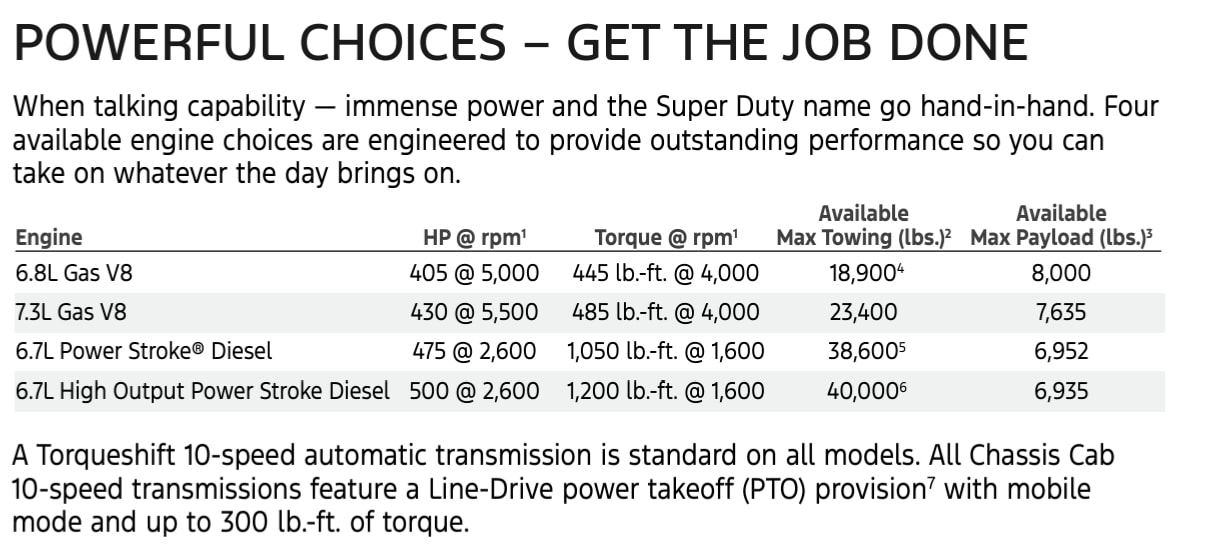
Super Duty Towing: Built to Take on the Toughest Jobs
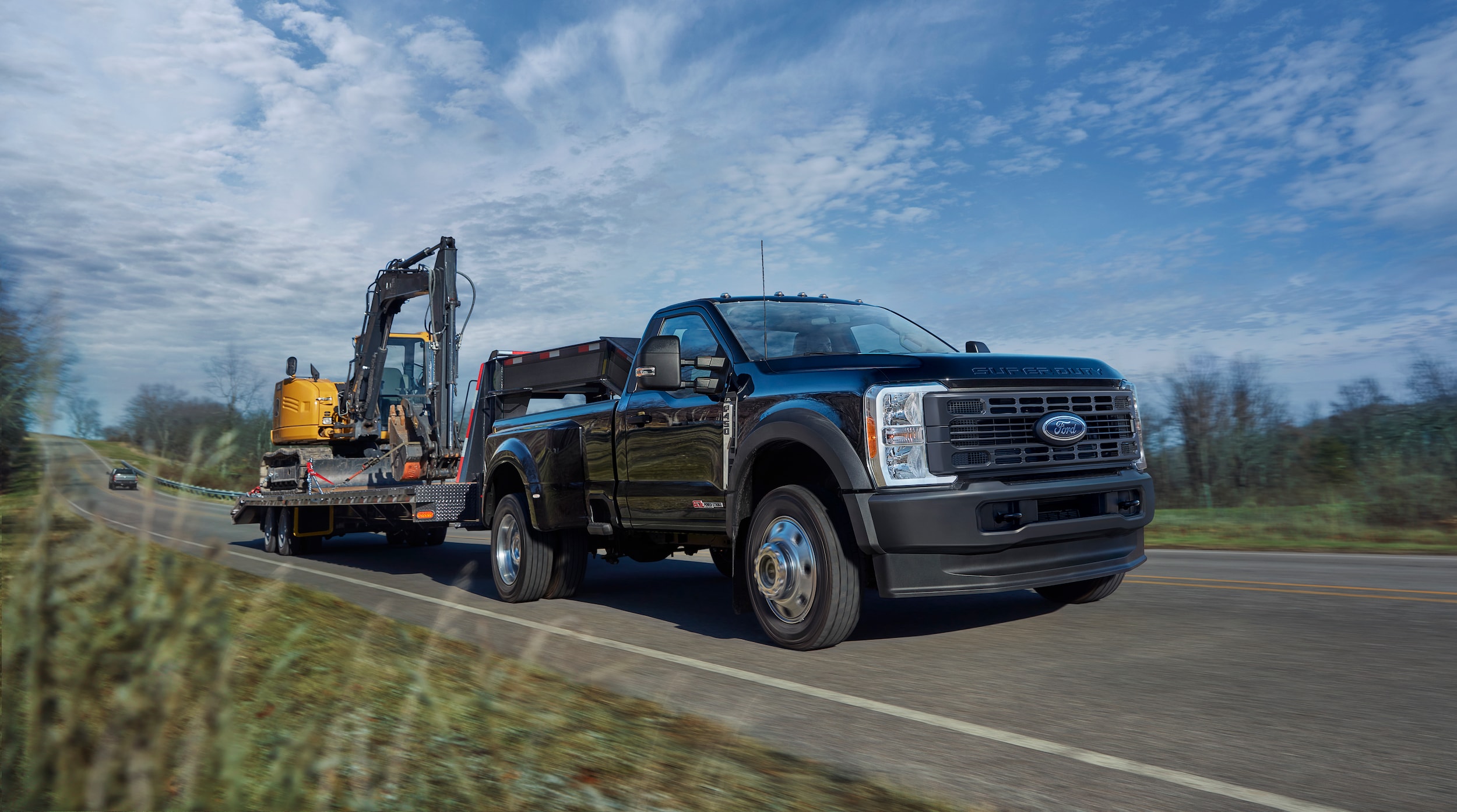
When the job demands serious power, the Ford Super Duty steps up to the challenge. Designed with class-leading towing capabilities, advanced trailering technology, and unmatched durability, the Super Duty is your ultimate partner for hauling heavy loads. Whether you're pulling a trailer for work, recreation, or farming, the Super Duty offers the strength, stability, and confidence you need to get the job done right.
With features like Pro Trailer Backup Assist™, integrated trailer brake control, and best-in-class towing ratings, the Ford Super Duty ensures smooth, controlled performance even under the heaviest demands. Take on any task with ease-because with Super Duty, no load is too big, and no journey is too far.
Get ready to tow smarter, safer, and stronger with the Ford Super Duty.
FAQ's
Ford trucks are equipped with advanced towing technologies, including:
- Pro Trailer Backup Assist™: Makes reversing a trailer easier by allowing you to steer it with a knob.
- Integrated Trailer Brake Controller: Improves braking performance when towing heavier loads.
- Smart Hitch: Helps optimize weight distribution and provides guidance for safe towing.
- BLIS® (Blind Spot Information System) with Trailer Coverage: Monitors blind spots, including those of your trailer.
To calculate your towing weight limits, you need to know:
- Gross Vehicle Weight Rating (GVWR)
- Gross Combined Weight Rating (GCWR)
- Payload Capacity
Subtract the truck’s curb weight, passengers, and cargo from the GCWR to determine how much you can safely tow. Refer to your vehicle’s manual or the Ford Towing Guide for precise information.
Still Have Questions? Contact Us.
* Indicates a required field